Techyst
A privacy-first AI diagnostic assistant for small phone repair shops in Indonesia. Built as a hybrid vision + reasoning product using Claude 4.5 Sonnet, with local-first storage so customer data never leaves the device.
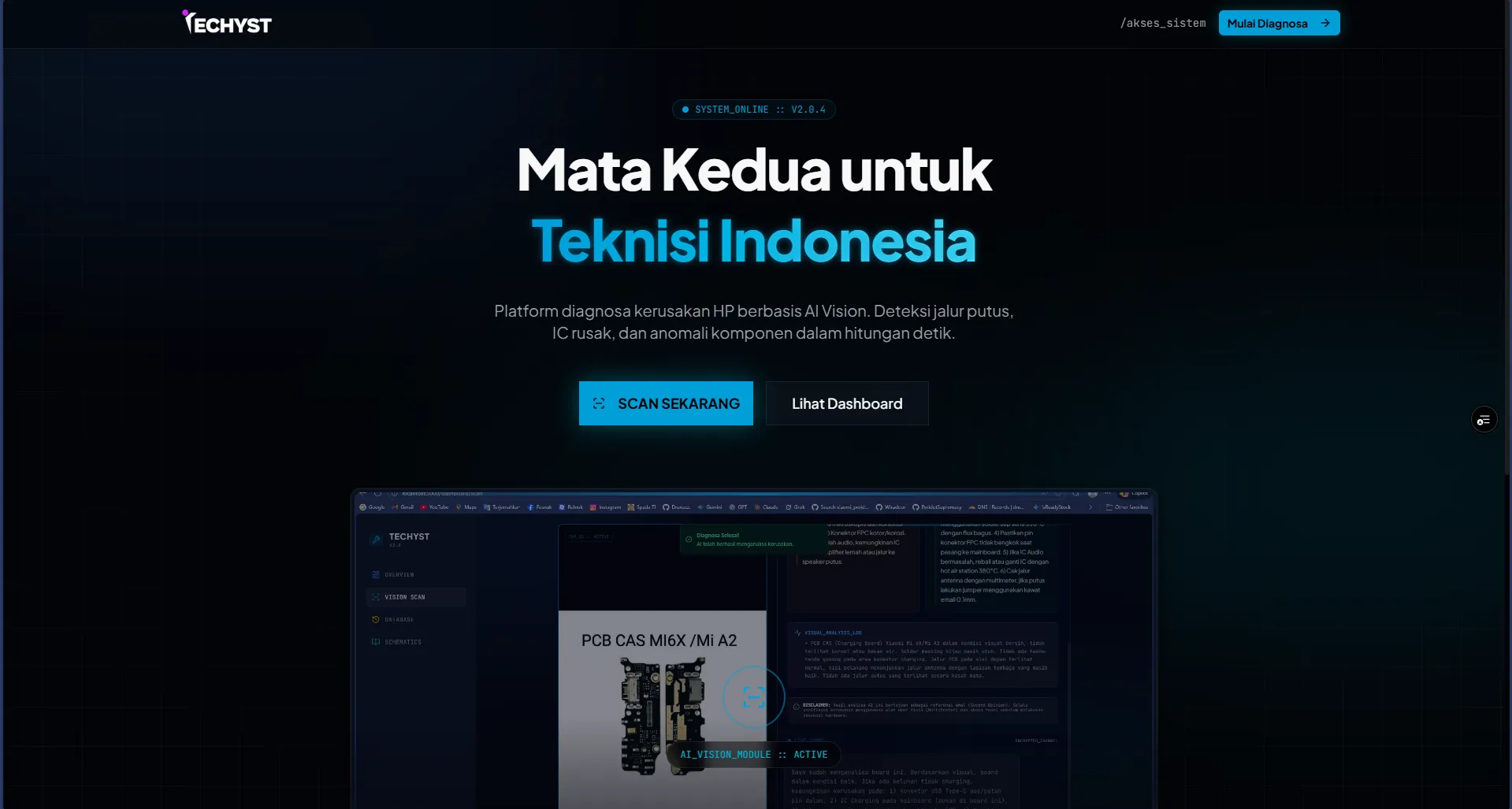
Techyst is one of the top 5 winners of the IMPHNEN 2025 AI Innovation Hackathon. It started from a simple observation: thousands of self-taught phone technicians across Indonesia diagnose modern motherboards every day without schematics, and the existing AI diagnostic tools either upload customer hardware photos to public cloud databases or demand expensive enterprise plans that small shops cannot afford.
Techyst acts as a “second pair of eyes.” Built with a strict privacy-first approach, it lets a technician run a high-accuracy visual diagnosis on a phone motherboard without ever sending customer service data to a third-party cloud database.
Key Features
- Hybrid AI Engine: Orchestrates Claude 4.5 Sonnet for visual inspection (Vision) and logical reasoning (Reasoning) to deliver precise diagnosis results.
- Visual PCB Diagnosis: Detects microscopic components (ICs, traces, resistors) even on blurry phone photos and overlays the suspected fault location.
- Context-Aware Technician Chat: A chatbot trained on local workshop language that walks the technician through the repair step by step.
- Local-First Storage: Uses IndexedDB to store diagnosis history and high-resolution photos entirely in the browser, keeping UMKM customer data private.
- Optimistic UI: The interface feels instant and responsive even while the heavy AI processing runs in the background.
Technical Challenge
The hardest part of this project was balancing Vision AI accuracy with privacy and performance. Sending high-resolution photos to a remote AI server usually means high bandwidth usage and the risk of sensitive customer data being stored by the model provider.
The fix was aggressive client-side processing. We compress photos in the browser before upload and use a serverless architecture that only acts as a thin proxy to the model API without any persistent storage. App state is held in IndexedDB through idb-keyval, which makes the app feel snappy while keeping the data 100 percent owned by the user.
Tech Stack
- Framework: Next.js 16 (App Router)
- Language: TypeScript (strict mode)
- AI Core: Kolosal AI SDK (Claude 4.5 Sonnet)
- Styling: Tailwind CSS v4, shadcn/ui, Framer Motion
- State and Storage: React Hooks, IDB-Keyval (local NoSQL)