FoodQCheck
A capstone AI product that screens the visual quality of UMKM dry snack products from a smartphone photo. React/Capacitor client, Cloudinary upload, FastAPI inference, and MobileNetV2 classification.

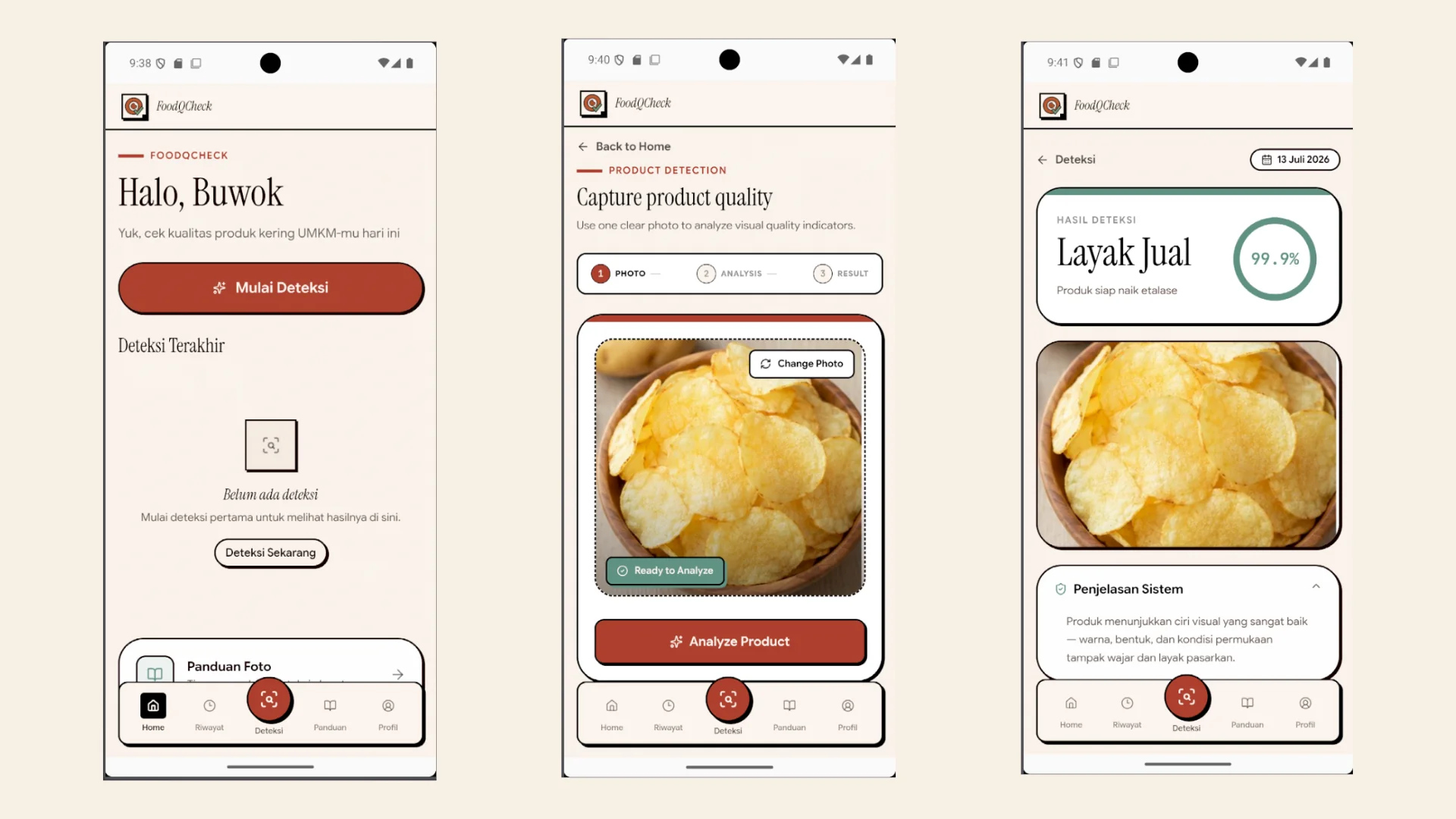
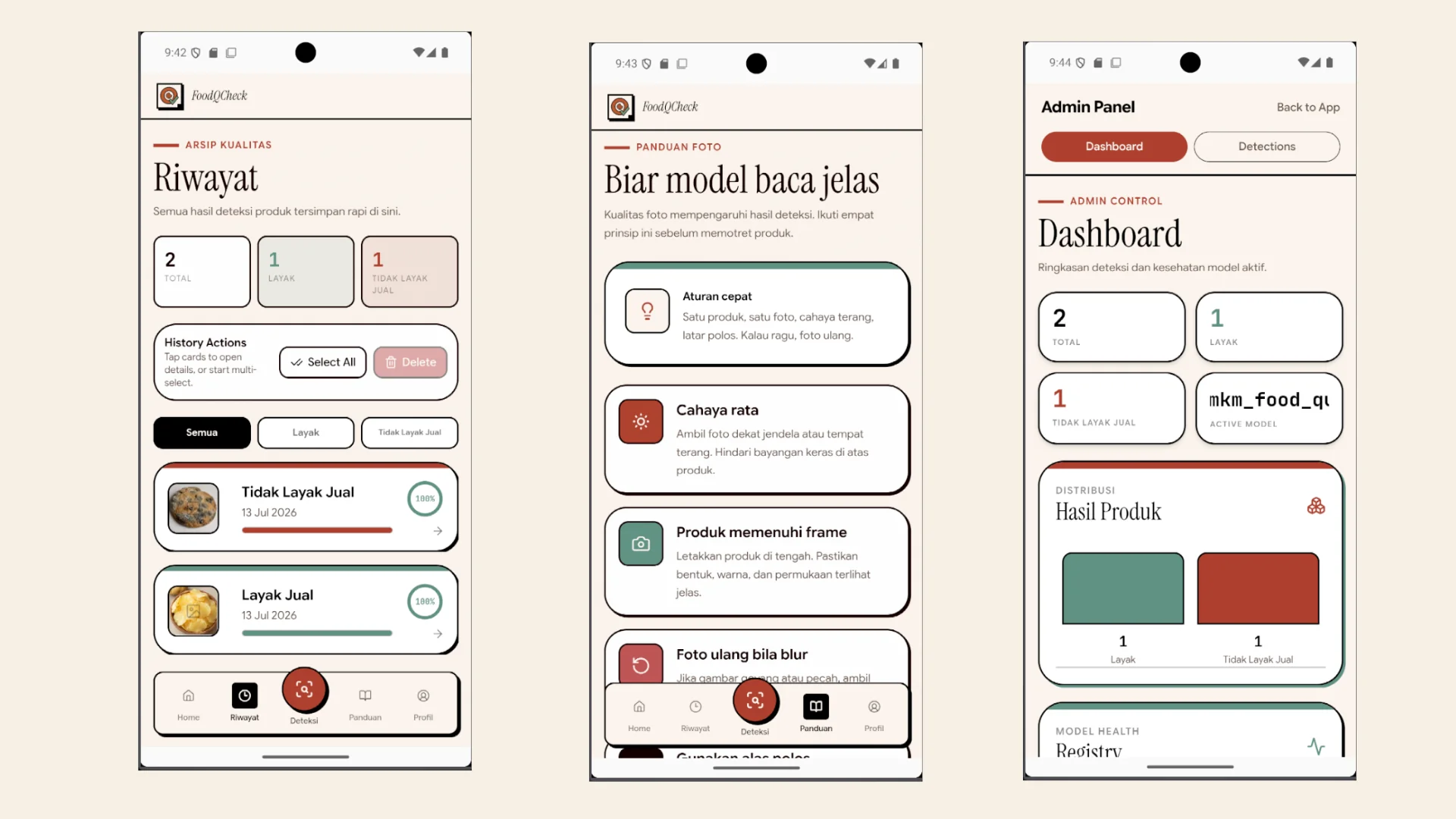
FoodQCheck is my D4 Software Engineering capstone project at Politeknik Negeri Padang. It helps UMKM producers of dry snack products (keripik, kerupuk, biskuit, and kukis) run a quick visual quality screen from a smartphone photo before a product goes to market.
The system is deliberately scoped as a visual pre-screening tool, not a food-safety certification system. It does not replace chemical, microbiological, or laboratory testing. Instead, it answers a practical production question: does this product look visually sellable or not?
Key Features
- Camera-to-result workflow: Capture or select a product photo, upload it, and receive a
Layak JualorTidak Layak Jualdecision with confidence score and short explanation. - Cloudinary-first image pipeline: The mobile client uploads photos to Cloudinary, then sends only the image URL to the inference API.
- MobileNetV2 inference API: FastAPI downloads the image, runs preprocessing, classifies with MobileNetV2, and stores the result with model version and threshold metadata.
- Detection history: Users can reopen previous results, review details, and manage their history.
- Admin dashboard: Operators can inspect detection volume, review records, and inspect model-facing artifacts such as Grad-CAM heatmaps.
- One React codebase, two clients: The same React app ships as a web SPA and an Android APK through Capacitor.
Technical Challenge
The hardest part was shipping a complete product loop under real capstone constraints: small visual dataset, server-side inference, mobile capture quality, and a result format that non-technical UMKM users can understand.
The solution was a clear end-to-end architecture:
React / Capacitor app
        ↓
Cloudinary image upload
        ↓
FastAPI receives image_url
        ↓
SSRF-guarded download + MobileNetV2 inference
        ↓
PostgreSQL stores detection history
        ↓
User result + admin review UI
On the model side, I used transfer learning with MobileNetV2, binary sigmoid output, and a production threshold of 0.3 chosen to prioritize recall for visually unsuitable products. On the product side, the API stores enough metadata: label, confidence, raw score, threshold used, model version, and explanation. So every result remains auditable after the demo ends.
Outcome
On the held-out test split of 72 images from a curated 509-image dataset:
- Accuracy: 91.67%
- Macro precision / recall: 91.74%
- F1-score: 91.67%
- Recall for
Tidak Layak Jual: 94.29%
The software side covers authentication, detection, history, admin review, Docker deployment with Caddy and PostgreSQL, and API contract tests. The project has been presented as a complete capstone system.
Tech Stack
- Mobile / Web: React 19, TypeScript, Vite, Tailwind CSS, Capacitor Android
- Backend: FastAPI, SQLAlchemy, Alembic, PostgreSQL, JWT auth
- Machine Learning: TensorFlow, MobileNetV2, Grad-CAM, custom training/evaluation pipeline
- Infrastructure: Cloudinary, Docker Compose, Caddy, Gunicorn/Uvicorn
- Source:
- Backend + ML: umkm-food-quality
- Mobile client: umkm-food-quality-mobile